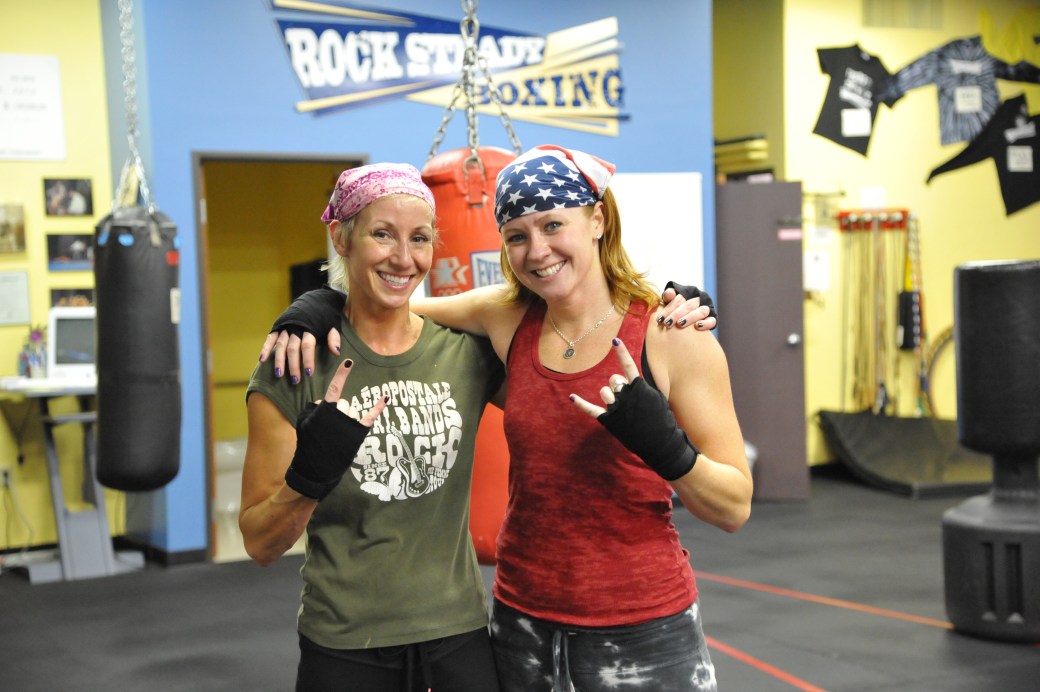
Unique boxing program brings empowerment to Parkinson’s patients

DSC_1602Nobody uses the wheelchair accessible parking spot in front of Rock Steady Boxing. It’s Thursday morning, and the rest of the parking lot is full at the industrial park just northwest of Indianapolis.

Inside the gym, a gaggle of about 30 people clad in workout clothes lines up along the apron of a boxing ring. Forty-year-old men are elbow to elbow on the ropes with women in their 80s. Black, white, truckers, retired military, housewives and musicians. Some of their hands are taped, ready for the starting bell. Many of them wear a different shade of the same Rock Steady T-shirt, back emblazoned with the slogan “Fight back.”

All of these fighters have a common, insidious foe: Parkinson’s disease. If any of these patients were trying to straighten a stooped posture or still a trembling limb for the sake of their classmates, Kristy Rose Follmar quickly diffuses any pretense. A drill sergeant with short red hair, broad shoulders and a sleeveless navy T-shirt that reads “COACH,” Follmar addresses her pupils as “Parkies,” shorthand for people with Parkinson’s disease. Her voice echoes in the metal rafters high above as she orders the class to spread out across the concrete floor and stretch.

“Shake everything out!” she says. Then a smile: “On purpose!”

“You’ve got to laugh about things,” Follmar later says. “It gets pretty heavy at times.”

Heavy, as in a man falling and the entire class cheering him on as he crawls back to his feet. As in a husband coming to class with his stricken wife to be her “corner man,” working out alongside her and helping her face this relentless and progressive attack on her nervous system. As in regulars suddenly not showing out of shame or frustration or depression, or because the disease has temporarily — or finally — prevailed, as it inevitably does.

There is no cure for Parkinson’s, but that doesn’t mean it can’t be confronted. In this gym, Follmar and her team teach people how to fight — literally. Ten years ago, Follmar helped start the first Rock Steady, a non-profit gym that preaches the use of repetitive, non-contact boxing training to improve Parkinson’s patients’ strength and coordination to help them stave off this unrelenting disease.

The idea has been contagious. What started with six members in a cramped Indianapolis shop has spread to 36 states and Italy, Australia and Canada.

When the stretching is done, Follmar walks over to the stereo and pushes play on an ’80s and ’90s R&B mix. As Salt-n-Pepa’s “Push It” comes on, she sets the digital timer for four-minute rounds. She slips on a pair of red punching mitts and slaps them together.

“All right, Parkies,” she says. “Let’s go!”

Read the rest at espn.go.com
Female Drivers Changed The Fortunes of One Racing Company

42f1b336-7a0d-4309-a638-8b336da157e4

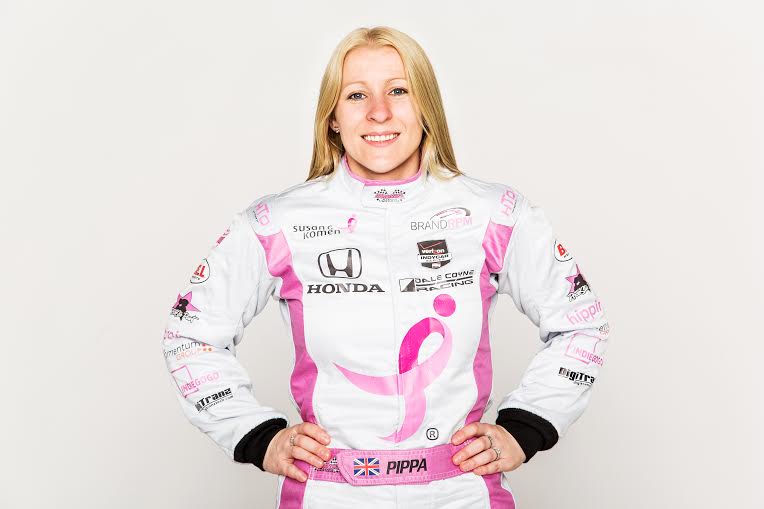
Pippa Mann grew up trying to fit into a world that wasn’t made with her in mind. The racing karts she first revved up at age 12 were considered boys’ toys, and the garages, pits and tracks she frequented as a teen in Britain and Italy had been informal fraternities for generations. In 2009, the 26-year-old Mann crossed over to the U.S. to race Indy Lights, a feeder series to IndyCar, whose most coveted prize — the Borg-Warner Trophy, given to the winner of the Indianapolis 500 — is topped by a sterling silver sculpture of a naked man.

And through it all, as Mann strapped on her helmet and climbed behind the wheel, she, like almost all female drivers, was wearing an off-the-rack racing suit that was designed for a man. “I’m a slightly different body shape than most of the other drivers,” she quips. “As a female driver, I have struggled to find suits that fit me throughout my career. Most of the time, I just wore bigger suits.”

Even in the cramped cockpit of an open-wheel race car, Mann learned to steer and shift in the extra padding, and throughout her amateur days and early professional career, a slightly baggy look was a small sacrifice for the safety of a flame-retardant uniform. But in Indy, a league in which companies invest tens of thousands of dollars to put their names on cars and suits, appearances were at a premium. So before her first year in Indy Lights, her team sent her measurements to a company for a custom-made firesuit, which didn’t fit at all. “It was tight in all the wrong places,” she says. “I wasn’t comfortable driving in it.”

They tried again with the same company, this time sending Mann in for a personal fitting — a man wielding the tape measure — and the result was even worse. “It was back to off-the-rack,” she says.

Two years later, having graduated to IndyCar, Mann and her team, Conquest Racing, were scurrying for sponsorships to back the driver’s first ride in the Indy 500. Even though everything was being thrown together in the weeks leading up to the Memorial Day weekend event — as is typical for smaller teams — Conquest didn’t want Mann’s first step onto the sport’s grandest stage to appear haphazard, for both her sake and that of the sponsors. Rather than patching the logos slapdash onto her uniform, Conquest sent the suit to Hinchman Racing Uniforms, a small local shop that had been doing Conquest’s embroidering. When Mann came in to try on the suit, Hinchman’s owner, Nancy Sullivan Chumbley, noticed that the garment hung awkwardly from Mann’s broad shoulders down her athletic 5-foot-5 frame, and offered to tailor it for her.

Hinchman is an old name in Indianapolis racing wear, dating back to the 1920s — so old that, by 2011, it had been practically forgotten. Mann had certainly never heard of the company. It was days away from the biggest race of her life, and given her previous experience with tailor-made suits, she was plenty skeptical. But, as a woman, Chumbley seemed to understand the issues that Mann was bemoaning. Chumbley was willing to work with her, talked things out rather than just relied on the rigid inches of a tape measure, and seemed motivated to find something that fit and looked good, something they both could be proud of. Mann agreed to let Hinchman make the suit.

Days later, despite starting second-to-last in the 33-car field and having mechanical problems with her onboard hydration system during the race, Mann crossed the Brickyard finish line in 20th place, third among Indy rookies. Back in the pits, she climbed out of the cockpit wearing a form-fitting, lightweight, black-and-white firesuit with her name stitched into the belt and the double-checkered-flag logo of Hinchman on the collar. “It was the best suit I’d ever had,” Mann says.

Read the rest at espn.go.com