The Last Trawlers

0412_Feature_ShrimpPhotoMichael Boone can find the sea with his eyes closed. He peers into the black of 3 a.m. from the helm of the Little Man, hands on the pegs at ten and two, guiding the seventy-five-foot fiberglass trawler slowly down the narrow Darien River toward the Atlantic. The only light is a half moon and an electronic depth finder that throws the young captain’s reflection onto the pilothouse window. Michael barely looks at the instrument. He knows by heart every rock, every coil and curve of the grassy shore, every jut in the shallows and hunk of debris that lurks just beneath the calm, dark surface. He has run these eleven winding miles, in blinding rain and fog, since he was twelve and had to stand on a milk crate his daddy bolted to the floor so he could see over the wheel.

Michael’s feel for these waters reaches beyond his own experience. He inherited this path from his father, who learned it from his father, who learned it from his. Four generations of Boones, one of several families puttering out from Darien, a small town sixty miles down the coast from Savannah, to scour the ocean floor for shrimp. And other than a few tweaks in navigational technology and creature comforts like an air-conditioned cabin, the shorted-out TV in the back, and the clunky flip-phone that does little more than take calls and tell time in his pocket, Michael operates pretty much in a clearer snapshot of how his grandpa, Sinkey Boone, fished, the way so many men have shrimped off Georgia for more than sixty years. There aren’t as many of those men as there used to be. The Little Man slips past several boats, tow arms up, paint-chipped hulls barnacled, bobbing idly at dock along the river. More than 200 boats once trolled here. Now there are maybe half that. Buildings are shuttered, piers in disrepair. Darien is quiet. Some families, like the Skippers, have sold off their fleets and their docks. Others cling to the helm only because they have nowhere else to go. Michael started skipping school at age eleven to join his father on the boat. Today, at twenty-three, he is easily one of the youngest boat captains—perhaps the youngest—in these parts, an exception to a new Darien generation that has been steered away, if not discouraged by the old guard, from the sea, Michael’s two older brothers included. These waters, after all, are troubled. The price of gas is too high, the price of shrimp too low. The market has been flooded by competition from shrimp farmers, foreign and domestic. Wild Georgia shrimp are scarce at the neighborhood restaurant and grocery store. Worse, nobody seems to know enough about the homegrown variety to ask. And meanwhile the nets’ harvest is not as bountiful as it once was.

Michael Boone stares ahead, piloting the Little Man out of Doughboy Sound and into the ocean, choppy waters slapping against the hull. He gently opens the throttle, revving the ancient engine in the belly of the boat to life. Course charted, speed leveled at just over eight knots, Michael leans back in his captain’s chair. He holds the giant wooden wheel with an outstretched foot and rests his hands behind his head. Outside, the unseen sun traces the horizon with a thin white line as night lifts over a boundless sea.

In the distance, he counts one, two, three starlike specks scattered on the water—lights from the decks of other shrimping boats, working through the night. Michael can envision a much different scene from not so long ago, lights almost innumerable, a skyline at sea. “There used to be twenty, thirty, forty boats out there,” he says flatly. “Twenty years ago, this was a city.”

Back on the mainland, the city of Darien—population 1,900, seat of McIntosh County—is little more than a few streetlights whizzing by on a nighttime drive down I-95. But its position along a natural tributary, at the mouth of the Altamaha River, made it a boomtown in the 1800s and early 1900s. The river rafted large loads of longleaf pine and cypress from the Georgia interior into Darien to be milled and shipped around the world. In the 1940s, one of those log bundles floated a man named Tessie Boone from Tattnall County, two counties inland, to town.

By that time, more than a century of unfettered cutting had decimated Georgia’s timber industry. But Darien had already begun reinventing itself as a fishing town.

Read the rest at atlantamagazine.com
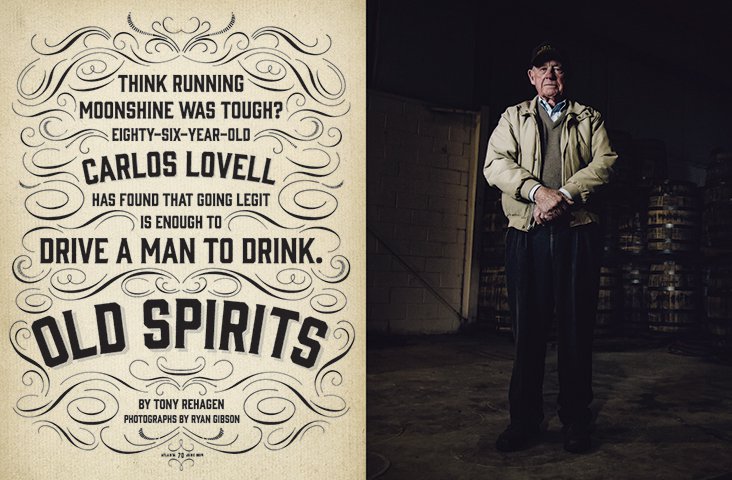
Old Spirits

moonshiners02I am in the passenger’s seat of a Chevy Silverado winding through the foothills of northeast Georgia, trying to learn the story of Carlos Lovell. But fifteen minutes into the drive, the man has barely uttered ten words from behind the wheel, and frankly, his deep, jowl-draped frown has silenced me in fear that the wrong question might land me in the ditch. The only sounds in the cab are Rush Limbaugh on the AM radio and the moan of the Chevy’s V8 pulling us up the narrow Habersham County mountain roads.

Carlos Lovell is eighty-six, and this interview was definitely not his idea. I don’t think he even knows my name or whom I’m with; he never asked. He refers to me as “that reporter fella”—even when I’m standing five feet from him. He tells his employees I “ask too many questions.” At any rate, I get the feeling the old man would much rather be working. Besides, he has never been much of a talker. For almost half his life, his family’s income—not to mention his freedom—depended on discretion.

Lovell was a moonshiner. At age sixteen, he started cooking illegal liquor and selling it by the truckload throughout North Georgia, right under the noses of local authorities. He and his brothers learned the practice from their father, Virgil, who himself had learned it from his uncle. Off and on for a hundred years, beginning in the 1860s, remote patches of these timberlands were thick with the warm scent of boiling corn and the thump, rattle, and hiss of a Lovell copper still.

The Lovells were far from alone. Since the eighteenth century, alcohol was a common by-product of some American farms, not unlike butter or cheese that came from excess milk. Barrels of whiskey were more valuable than silos of corn. Some farmers kept it for themselves; others sold it. In colonial times, whiskey was bartered as hard currency. But in 1862, to help pay for the Civil War, the federal government reinstated an old tax on distilled spirits (President Jefferson Davis outlawed the production of liquor to save grain for the Confederate Army). After the war, homemade spirits were a major, if illegal, commodity in the devastated agrarian South. By 1880 the Internal Revenue Service was seizing about 1,000 illegal stills a year. In 1924, the height of Prohibition, 13,023 moonshine operations were broken up across the U.S., and 2,824—more than a fifth of them—were busted in Georgia alone. The prevalence of illicit booze in Georgia gave rise to the mythical Southern moonshiner in a souped-up jalopy, racing police through twisted mountain roads, past still fires strewn like Christmas lights across the Smokies and by Appalachian springs spouting pure white lightning. Even today, it’s not unheard of for hunters in these parts to stumble upon a woodland still—since 2011 the Georgia Department of Revenue has dismantled eleven, most of them small operations evidently used for private consumption.

One night four years ago, as he tells it, Carlos Lovell rolled over in bed and decided that, after forty years out of the business, he would make whiskey again. And this time, he’d do it by the book. With savings from two decades of dealing in mountain real estate, Lovell built a distillery and expanded a warehouse right off of State Route 13, twenty-some miles from the old Lovell homestead on the outskirts of Clarkesville, the Habersham seat. He plastered the name Ivy Mountain—site of several of his old stills—on the distillery’s water silo, slapped his guarantee of the 150-year-old family recipe right beneath his picture on the label, and waited for the cash to flow like the old days, now clean and easy.

In one respect, Lovell’s timing could not have been more providential. After all, we are living in the age of the artisan, when the quest for “authenticity” means we’ll gladly pay $8 for a quart of lion’s mane mushrooms and $10 for a few ounces of fresh pasta. Why should our booze be any different? And what could be more “of-the-earth” than rediscovering the methods of hill folk who’ve crafted their own liquor for generations?

But in many ways, the wilderness of the modern marketplace has been more ruthless than any booze-sniffing police dog or power-tripping revenue agent. The artisanal movement means Ivy Mountain Georgia Sour Mash Whiskey is competing for shelf space not only with the barrel-chested Jack Daniels and Jim Beam, but also with a cluster of other like-minded boutique distilleries that have sprouted all over the region. In Lovell’s mind, the whiskey itself, born of experience and instinct that reaches back through his bloodline, processed with hard work and care, and sold for an honest price, should be enough to set Ivy Mountain apart. But his daughter, his employees, and the marketing firm they hired know that nowadays consumers pay for image as much as product. They believe people will line up to buy “legal moonshine” straight from the mountain still of a Georgia legend. They just need to know the legend.

That’s why they’re prodding Lovell to lead public tours of his distillery, why they have this farmer who sprouts and grinds his own corn slouched behind a fold-up table at Costco, signing bottles of his 86-proof lifeblood alongside the hair-netted warehouse club employees who hawk toothpick meatballs and samples of granola.

And today, it’s the reason Lovell is reluctantly chauffeuring me, a complete stranger in broad daylight, to the mountain spring that, according to his spiffy new website, “the Lovell family has used for 150 years to make their legendary moonshine.”

We climb down from the truck, and Lovell leads me, sans blindfold, through the trees and across the hillside to a squat stone springhouse dating to the mid-1800s. Behind the building, a stream of cold, clear water runs downhill. Lovell tells me that, for a couple of decades while he was retired, he leased this land to a company that bottled it as drinking water. There’s unmistakable pride in his voice, but I also detect a touch of disdain—as if using the water for that purpose had been a terrible waste.

Back in Lovell’s office—an empty-shoebox room in the back of the distillery with a bare desk, three mismatched chairs, a phone on the cement floor, and a window looking out to the gleaming copper-and-steel industrial still that stands atop a five-foot riser—the boss lays down rules for our interview. When I pull out my iPhone and ask to record, Lovell waves it away. Another rule: No names. “Most of the people I did business with are dead,” he says. “But their family might still be around.”

Read the rest at atlantamagazine.com

The Crossing

1212_Feature_TheCrossingThe train that killed DeKai Amonrasi no longer exists. CSX Q612 out of New Orleans met its end at Tilford Rail Yard near Marietta Boulevard, a few miles west of Berkeley Heights on Atlanta’s west side. There its 120 cars—hauling refrigerators, automobiles, and sheet metal—were decoupled and classified by destination, 9,000 tons of metal and merchandise broken up and blended with that from dozens of other incoming rail cars. These new trains were bound for hubs like Charlotte, Chicago, and New York, where their payloads were delivered, the empty boxcars and hoppers eventually joining a new line. As you read this, the pieces of deceased donor Q612 are vital organs in dozens of trains across the continent.

Locomotive 9043, the blue-and-yellow, diesel-powered leader of Q612, re-fueled and moved on as well. Pulling its newest charge, 9043 is barely distinguishable from its fellow engines running along the 140,000 miles of rail sewn through U.S. cities and towns and the vast countryside that lies between them. Its shrill horn blasts through every crossing, briefly alerting the world to its presence and warning anything that might stand in its way.

Freight trains don’t run on tight schedules. The speeds of diesel locomotives like 9043 vary between 10 and 50 miles per hour, depending on track conditions and load weight. It is almost impossible to know exactly when the train is coming—at least in time to do anything about it. In Georgia, where there are more than 4,800 miles of active track, the sight of a train is commonplace. People busy on their own courses hardly take note. But the train is always coming. In ice, snow, wind, or rain. And by the time you hear the horn, it’s too late.

August 23

Herbert Sinkfield slides gingerly off the bed and into his slippers in the back bedroom of his house. The wooden cane he reaches for could be expected for an eighty-two-year-old retired bricklayer, especially one with bone cancer in his hip. But Herbert never needed it before the accident.

Read the rest at atlantamagazine.com

Sir Foster’s Rise to Organist Fame

Screen shot 2015-02-16 at 6.12.11 PMSIR FOSTER DIDN’T upstage the players at last year’s NBA All-Star Game in New Orleans, but he did create quite the stir. As Carmelo and KD dribbled and drove to keyboard renditions of OutKast and Kanye, the nation took notice. Suddenly, the organ was cool and the organist an unlikely star.

This was, of course, not news back in Atlanta, where classically trained Foster Carson was plucked from obscurity after answering the Hawks’ Craigslist ad in 2009. He began in the rafters but soon moved courtside, where he, as much as the scoreboard, now dictates the mood at games — improvising everything from Big K.R.I.T. to the White Stripes. “It’s a Broadway play,” Carson says, “and I’m the orchestra.” Says Hawks superfan Ludacris: “He’s providing the musical landscape.”

Some might say he’s also providing cover. Offseason scandals rocked the Hawks after a leaked email in which owner Bruce Levenson blamed poor attendance on black fans having “scared away the whites,” and after GM Danny Ferry said Heat forward Luol Deng has “some African in him.” Since then, the franchise has hired the NBA’s first “chief diversity and inclusion officer” and announced efforts to enhance the fan experience.

Who better for that than 27-year-old Carson? During a recent Hawks win, the Georgia native donned a Dominique Wilkins jersey and mimicked Nique with a windmill slam of the keys, pivoting from “DE-FENSE” to Van Halen’s “Jump” in the second it takes to whistle a jump ball. “I always wanted to play in the NBA,” Carson says. “I guess you could say I do.”

This article appeared in ESPN‘s Feb. 2 issue.

Shipped Away

roswell-h-400x500On any given workday, the stretch of Georgia 9 that cuts north-south through Roswell is a four-lane wall of cars. Almost as old as the city itself, the thoroughfare was once little more than a dirt wagon path called the Atlanta Road, connecting this mill town to the burgeoning railroad hub some twenty miles south.

The road also serves as a dividing line. To its west sits the tree-canopied town square, its centerpiece an obelisk water fountain bearing the names of Roswell’s founding families. Repeated on nearby street signs—Bulloch, Pratt, King—these are the surnames of wealthy planters and industrialists who, in the 1830s, moved inland to escape Georgia’s muggy, mosquito-infested coast. At the southern end of the square, a squat stone monument commemorates their leader, Roswell King, a banker, politician, surveyor, and plantation manager, “a man of great energy, industry, and perseverance: of rigid integrity, truth, and justice.” And on the hilltop beyond looms Barrington Hall, a columned, whitewashed mansion built for Barrington King, Roswell King’s eldest heir. The antebellum manor, like Bulloch Hall due west, has been restored as a museum, a memorial to the romantic affluence that for some is synonymous with the Old South.

On the east side of Georgia 9, as the hill drops toward the creek bottom, the architecture changes. The structures are smaller and more tightly packed together. One storefront with broad single-pane windows is dated 1854; it provided goods for employees of the Roswell Manufacturing Company, the King family’s cotton mills that once drew power from Vickery Creek and the labor of hundreds of women, children, and men to make cloth and thread and candlewicks. Farther downhill, you will find a cluster of brick row homes that housed the millworkers. These buildings line places with no-nonsense names like Factory Hill and Mill Street, but they once were home to the Woods, Sumners, Kendleys—and countless other families whose names have since been lost to history.

For decades, the two halves of Roswell coexisted in relative harmony. Then, in the summer of 1864, war came, exposing a divide almost as deep as any clash between North and South and setting the families of Roswell on divergent paths.

The Kendley family story starts with a bit of luck.

Read the rest at atlantamagazine.com