Do You Need More Salt?

more-saltWHEN AN EARTHQUAKE HIT JAPAN BACK IN March, tremors triggered seismographs more than 6,000 miles away in Texas. But what the quake really rattled on this side of the globe were the nerves of Americans: Once the news came out that the Fukushima Daiichi nuclear reactors had been damaged, people in the States began worrying that a killer plume of radiation might waft across the Pacific.

Within days, poison-control centers and state health departments as far east as Pennsylvania were fielding calls from people wondering about protection from an oncoming cancer cloud—specifically, questions about potassium iodide, a form of stable iodine that can guard a person’s thyroid gland against harmful radioactive iodine. The same pills that the U.S. government had issued to its employees in Japan were soon being hoarded by a public suddenly obsessed with iodine.

Of course, a nuclear storm never did sweep across the country. Somewhere between Fukushima and Fresno the danger dissipated, and gradually, so did our obsession with iodine.

But beyond this happy ending, another danger lurks. The risk of radiation may have vanished, but a national health threat remains. And we still need iodine to save the day.

LOCATED IN THE FRONT OF YOUR NECK, JUST below your Adam’s apple, the thyroid gland is often described as the thermostat of the human endocrine system. It regulates your body’s use of energy, and creates and stores hormones that control everything from your metabolism to your growth rate. The essential chemical for all these functions is iodine. Without enough of this element pumping through your thyroid, you may begin to experience fatigue, depression, lethargy, cloudy thinking, and weight gain. Left untreated, an iodine deficiency may potentially cause thyroid cancer and, some doctors theorize, even heart disease.

Fatigue? Lethargy? Cloudy thinking? Right: This pretty much describes the symptoms of every man in America on any given workday. But what if what you’ve come to consider just a case of the Mondays is actually an out-of-whack thermostat? And what if the belly fat that so many men can’t seem to shed exists at least in part because of a metabolic malfunction?

Read the rest at Men’s Health

The Blink of an Eye

mattwhite500The gear is gathered on the lanai—a half-dozen7-foot spinning rods, lined and hooked, along with a pair of dusty tackle boxes stocked with lures and weights. Down at the dock behind the house, a wide-decked, 23-foot Carolina Skiff bobs in the canal; in the kitchen sits a cooler packed with snacks and sandwiches. In the master bedroom, just off the lanai, Matt White watches SportsCenter highlights of last night’s Butler basketball game with one eye on the sky. Yesterday, the weather report said there was a 30 percent chance that a front moving toward Cape Haze from the Gulf of Mexico would produce rain—an event that would end Matt’s day before it begins.

Matt has been fishing the brackish Florida waters south of Sarasota since he was a boy on his family’s yearly vacation. His parents moved here from North Manchester, Indiana, while Matt was at Butler, and in the summers, he would often take his pole and go out alone. When Matt retired to Cape Haze seven years ago, he would fish at least twice a week, landing trophy specimens of just about every species that swims these parts. Shark and tarpon are the only prizes he still dreams about.

But it has been more than a year since Matt, 44, last got out on the water. He can’t just grab his gear and walk down to the dock. For the past decade, much longer than anyone, including himself, thought he could survive, he has lived with amyotrophic lateral sclerosis—ALS, or Lou Gehrig’s Disease—which damages the nerves that control voluntary muscle movement. Today’s excursion has required a week of careful preparation.

The mechanical boatlift that Matt and his father, Howard, designed and modified had to be tested to make sure it could still lower Matt’s 600-pound motorized wheelchair into the skiff. The batteries for his portable ventilator had to be charged, along with those that power the machine that his wife, Shartrina, uses to suction his saliva. The laser-triggered contraption that runs his specialized reel, enabling Matt to fish using only his eyes—the sole part of his body he can still control—needed to be checked as well.

In his mind, Matt has it all laid out: captain booked, schedule set, supplies inventoried. Everything down to what he will wear. All he has to do now is relay that last bit of information to Shartrina.

She emerges from the walk-in closet, frustrated. She bends to look into her husband’s bright blue eyes. “Wind shirt?” she asks. “What is it, a jacket?”

He stares back at her.

“A pullover?”

He blinks once.

“What color is it? White?”

He doesn’t blink.

“Blue?”

No blink.

“Black?”

Blink.

She goes back into the closet for about a minute and reemerges with a plain black windbreaker. “Is this it?”

No blink. Matt then shuts his eyes three times to signal that he wants to initiate their system. Numbers represent groups of letters: 1=A-D, 2=E-H, and so on. He found it on the Internet. Shartrina begins to count, “1, 2, 3, 4, 5.” Matt blinks on 5. Q-T. Shartrina recites, “Q, R, S …” Matt blinks on S. Slowly, number by number, letter by letter, he spells out S-T-O-N-E-H-E-N-G-E.

“It says ‘Stonehenge?’” she asks. “I don’t see anything like that in here.”

He just looks at her.

She rolls her eyes and turns back to the closet, muttering to herself: “He remembers everything he’s ever owned.” Matt’s mother, Connie, joins the search, and the two scour every closet and drawer in the house. It is almost 9 a.m. The sun is out, the sky is clear, and the boat captain will arrive any minute.

Shartrina returns with a white pullover. “I cannot find it, and I don’t have time to look,” she says. “Will this do?”

The two lock stares, and for a moment there is silence, broken only by Matt’s ventilator beeping and huffing and releasing. After about 30 seconds, Shartrina exhales and throws up her hands.

“All right,” she says, marching out of the bedroom. “I’ll look one more place!”


ALS attacks the nerves in the brain and spinal cord. Slowly, the motor neurons that send and receive impulses wither and die, cutting off communication between brain and muscle. Symptoms start as weakness, usually in an extremity, like an arm or a finger. Then the disorder spreads, killing nerve cells as it works its way through the body. No one knows the cause. Most patients live only two to four years after diagnosis. There is no treatment or cure. After a decade with the disease, Matt’s frame is a long, gaunt twist of skin, atrophied muscle, and bone; his hands, feet, and face limp and elongated.

But the disease does not impair the nerves that carry sensation. Matt can still feel the heat of a Florida summer, or, more often, cold, due to his drastically decreased body mass. He can feel the tickle of his little Maltese, Abby, licking his feet, and the warmth of a good-morning kiss from Shartrina.

Read the rest at Indianapolis Monthly

A Lot To Lose

spreadHere comes Rich Burd, emerging from the rows of gleamingautomobiles, extending his hand in your direction as if he’s been expecting you. You’ve seen him before, in his cheesy TV commercials—“Haven’t you heard? Burd’s the word!”—and here he is in the flesh. He’s a bit shorter than you expected, but there’s that same round face with heavy eyelids, the same blond buzz-cut standing motionless in the breeze, the same knowing smile. He wants to welcome you to his kingdom of freshly washed and waxed coupes and sedans, half-tons, full-tons, SUVs and hybrids, if that’s your thing, each adorned with a bright-colored balloon and priced to sell. He grips your hand firmly, looks you in the eye, and asks if he can show you something, as if he already knows exactly what you want, what you need, and what you can afford.

Rich is a salesman, after all, a pro, a closer who built the shimmering white 55,000-square-foot Burd Ford showroom and service center looming behind him brick by brick, sale by sale, starting at age 19. And he is more than owner and namesake. He is the father of this place, this supermarket of cars, and its salespeople and mechanics are as much a part of him as his wife and kids. Everything—from the classic rock on the sound system punctuated by thunderous, distorted pages to the lightbulbs behind the blue B-U-R-D sign—runs on his unbridled horsepower. Shake that hand, take those keys, and drive off in a Burd Ford, and you’ll become part of that extended family for life.

So what can he put you in? Need towing power and hauling capacity? There are some F-150s hot off the line. Packing the family around? How about a roomy Expedition, like the one Rich’s wife drives? Concerned about the price of gas? Friend, who isn’t? It’s 2009, and pretty much everyone is hurting. Rich knows you’ve been up late at the kitchen table, bracing for the worst. He understands that at the top of every household’s list of resolutions is squeezing a few thousand more miles out of the family car.

But what you may not realize is that Rich has been up nights, too. He has spent hours in his office, sweating beneath mounting piles of red numbers. The office window is one-way tinted glass. Rich can look out on his fleet of unsold cars, but you can’t see in. You don’t know that Rich once sold more than 130 cars a month from this lot. Or that there have been months this year when he has moved fewer than 80. That in order to build this state-of-the-art facility, Rich Burd gambled big, $8 million–big, just before the crash, when the car business bottomed out. You don’t know that he is still waiting for his $300,000 Cash For Clunkers check. You can’t see the framed photos on the shelf above his desk, a wife and four children looking down, counting on him to pull the family through.

Even they can’t see how bad it has gotten. His best friend, Chris, his spouse of 22 years, can’t guess the weight of the burden Rich has lately felt bearing down upon him when he shuts that office door. No one sees what this economy is really doing to Rich Burd. No one knows it will kill him.

Rich Burd was born a car man. His father, Gill Burd, was an auto wholesaler who moved his business here from Kentucky when Rich was 11. At local auctions, Rich observed his father’s skill at sniffing out a deal, watched him bid on clunkers to be hauled back to the family shop and refurbished and sold to dealers for a tidy profit. The elder Burd imparted his knowledge to his son, but he was a stern boss. “His dad was a pretty hard guy no matter who you were,” says Jon Parson, a childhood friend of Rich’s who also worked for Gill. In his early years, Rich toiled in the shop, detailing cars. When he was old enough, he ran rehabbed Oldsmobiles, Fords, and Cadillacs on the highways and back roads between auctions and dealerships all over Indiana.

Read the rest at Indianapolis Monthly

Free Man

FreeManJPGThe cell phone ringing in the driver’s hip pocket startles the man in the passenger’s seat. It’s a sound he has never heard before. He asks if he can answer it. The driver, his sister, shows him how. On the line is his sister’s daughter, an adult niece he hasn’t seen since she was a child. She asks where they are.

David Scott takes a look around. He knows this place. He grew up here. But the world outside the car window doesn’t quite match his memories, the mental blueprints that he has held onto for so long: A furniture store still open for business behind boarded windows. A drive-in still bustling with carhops in gleaming white roller skates, now an empty lot. Virgin farmland still rolling beneath what are now flat fields of concrete, streetlights sprouting like giant weeds. He tells her that they are on their way.

The date is January 28, 2008, and, after serving 23 years for murder, David has just been released from prison. DNA pulled from the crime scene finally showed authorities what David, his mother, and his two half-sisters have been trying to tell them for more than two decades—that a different man was in Loretta Keith’s house the night she was killed. That he had been wrongly convicted.

There were plenty of reasons for no one to listen. At the time of the killing, David was a poor 17-year-old boy from the wrong side of the Wabash River. He had a learning disability, and he would lash out, sometimes violently, often running afoul of the law. Even worse, he was prone to telling outrageous stories about himself. And one night, goaded by a man who claimed to be his friend, he bragged about how he had done the deed. Twenty-three years gone, for one lie.

This morning he stuffed his inmate’s uniform into a lawyer’s wastebasket, hopped into his sister Bonnie’s car, and turned onto U.S. 41 out of Terre Haute, toward what he hopes will be a new beginning, a chance to resume his life. At his niece’s house in Youngstown, eight miles south, his mother is waiting to see him.

In the driveway, David springs from the car, up the steps, and into the house. Every night at 9 p.m., for the past 23 years, he and his mother have knelt and prayed, each knowing that the other was asking for this reunion. Hundreds of letters have passed between them, each one written in anticipation of the day they would be under the same roof again. He sees her sitting at the kitchen table with her back to the door. Her arms and legs are swollen, and an oxygen tube curls beneath her nose. He overhears her talking about the days when her children lived together back in West Terre Haute. Seeing his moment, he slips into the chair beside her. “I remember those days,” he says, “like they were yesterday.”

She turns to him, confused. “You do?”

“I grew up there,” he says.

When he was sent up, he was barely shaving. Today he is a sinewy, tattooed product of more than two decades in a state penitentiary, all menace and threat. Bald, rough, and wary. When he tells her who he is, speaking the name she gave him, she begins to sob so hard she can hardly catch her breath to speak. One prayer, for this, every night for 23 years. Now he’s here. And his own mother doesn’t recognize him.


David’s mother died 39 days later.

Sipping coffee at Bonnie’s dining-room table, David looks at a framed pencil portrait of his mother, propped up in a corner of the room. He sketched her, smiling, from a wallet-sized photograph in his cell. Now it’s the way he wants to remember her. The doctors said it was renal failure. But he knows better. For two decades the woman fought with everything to bring him home. And when he was finally beside her, and she saw what prison had done to him, it broke her heart. David has never recovered the hope he lost in that moment, almost a year ago now.

Read the rest at Indianapolis Monthly

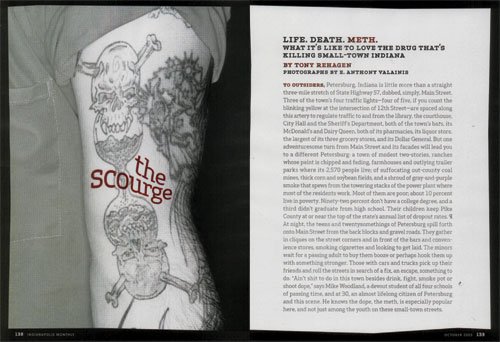
The Scourge: Life. Death. Meth. What it’s like to love the drug that’s killing small-town Indiana.

Scourge-SpreadTo outsiders, Petersburg, Indiana is little more than a straight three-mile stretch of State Highway 57, dubbed, simply, Main Street. Three of the town’s four traffic lights—four of five, if you count the blinking yellow at the intersection of 12th Street—are spaced along this artery to regulate traffic to and from the library, the courthouse, City Hall and the Sheriff’s Department, both of the town’s bars, its McDonald’s and Dairy Queen, both of its pharmacies, its liquor store, the largest of its three grocery stores, and its Dollar General. But one adventuresome turn from Main Street and its facadeswill lead you to a different Petersburg: a town of modest two-stories, ranches whose paint is chipped and fading, farmhouses and outlying trailer parks where its 2,570 people live; of suffocating out-county coal mines, thick corn and soybean fields, and a shroud of gray-and-purple smoke that spews from the towering stacks of the power plant where most of the residents work. Most of them are poor; about 10 percent live in poverty. Ninety-two percent don’t have a college degree, and a third didn’t graduate from high school. Their children keep Pike County at or near the top of the state’s annual list of dropout rates.

At night, the teens and twentysomethings of Petersburg spill forth onto Main Street from the back blocks and gravel roads. They gather in cliques on the street corners and in front of the bars and convenience stores, smoking cigarettes and looking to get laid. The minors wait for a passing adult to buy them booze or perhaps hook them up with something stronger. Those with cars and trucks pick up their friends and roll the streets in search of a fix, an escape, something to do. “Ain’t shit to do in this town besides drink, fight, smoke pot, or shoot dope,” says Mike Woodland, a devout student of all four schools of passing time, and at 30, an almost lifelong citizen of Petersburg and this scene. He knows the dope, the meth, is especially popular here, and not just among the youth on these small-town streets.


Methamphetamine came to town 20 years ago, when locals first learned that they could take a pitcher of anhydrous ammonia—liquefied nitrogen fertilizer—from a nearby farm, some lithium batteries, ether, and a couple boxes of sinus pills and make electric, chemical bliss. The drug accelerates the addiction process, taking hold of its users and leaving them exhausted, empty, and emaciated, desperate for another fix. Today this once-fringe drug has the entire county in a lockjaw grip. Since 1999, officials in Pike County—Indiana’s 85th most populous—have seized 95 meth iambs, 13th most in a state that is second in the nation. And Sheriff Todd Meadors says those are only the labs his department has stumbled upon. The county can’t afford the training or equipment for a meth-specific task force. Even so, nine of 10 Pike County arrests are meth-related.

The police reports posted in Petersburg’s weekly paper, the Press-Dispatch, are bulging with meth busts. The houses of 60-year-old men are being raided as meth labs. Third- and fourth-generation babies are born every day with the dope in their bodies, in their blood. Meth affects everyone, knows no boundary of class or gender. It’s now so prevalent that it’s impinging upon even those who’ve never used it: the elderly woman who goes to CVS to fill a prescription and has to wait in line behind people who must show ID to buy Sudafed; the mother who calls 911 because her toddler stepped on a discarded syringe in the park; the mushroom-hunters who fear that they’ll stumble across a meth lab and its tweaked, paranoid, gun-toting owner; the children left fatherless while Daddy goes to prison for methamphetamine. Daily, social workers remove children from clandestine labs—pulling them starving from where they sit on scorched carpet beside burnt spoons and needles, immune to the noxious stench of anhydrous that causes visitors to retch upon first contact, their parents either too spaced out or too focused on chasing the high to care. In this town, there’s no escape.


July 12. Woodland is a prisoner: Indiana Department of Correction number 156277, doing three years for conspiracy to manufacture and deal methamphetamine, a class B felony. He’s been in and out of this jail eight times in the last 10 years, doing weeks and months at a time for random drug charges. This is his third felony. A fourth will categorize him as a habitual offender, a tag that carries a mandatory sentence of at least 20 years.

Less than two weeks into his latest sentence, he sits in the Pike County Jail on Main Street in Petersburg, enjoying the air-conditioning he didn’t have in his mother’s trailer less than a mile down the road, reading paperback Westerns to fill the empty hours. A lean, muscular man, he does push-ups and sit-ups to stay in shape and burn his pent-up energy and frustration. He’s jittery, sometimes breaking into small bursts of nervous laughter when he talks. He constantly crosses and uncrosses his arms. He can’t seem to sit still. His sharp brown eyes are always wide and frantic, darting this way and that, as if he’s constantly surveying his surroundings. When he gets worked up, his unpredictability unnerves even his family.

Woodland is waiting to be sent up to a state penitentiary, which may not happen for some time. The DOC is currently housing almost 2,000 inmates in Indiana county jails due to overcrowding, which in turn is due largely to the increase in meth arrests. Indiana taxpayers spend an extra $35 per day per DOC inmate bloused in county jails. Pike County Jail pulls in between $300,000 and $400,000 a year housing DOC inmates. A facility that usually bolds about 60 now keeps 83 behind its bars. Inmates sleep on the floor.

Woodland says he won’t mind being sent to the pen, where at least he’ll have contact visits with his family. He could kiss his wife. He could hold his daughters—18-month-old Kaitlyn and 20-month-old Madison—instead of watching them cry and press kisses against the glass of the jail’s visitation room. He misses them, longs to bold them.

Kaitlyn and Madison are the reasons he’s in here. If not for them, he would have fled, lived as a fugitive in the woods or in some rural county in Illinois. He wants to get this over with. “I got to get out and get clean so I can be a father to my girls,” he says. “The longer I drag it out, the older they’re going to be when I get out.” But as much as he loves his daughters, he also loves the drug. In jail, just as outside, he thinks about it every day: the prick of the needle in his muscular arm, the slow drive of the fluid into his throbbing vein as he presses the plunger. The rush as it courses to his heart. Eyes wide, pulse racing as his beard pumps the bliss through him, biting every inch of his body, each extremity tingling beneath a tin glaze of sweat, a thousand simultaneous bursts of adrenaline, euphoria, as if his very soul were about to tear free. It’s like walking barefoot on a bed of cotton. Some women experience immediate orgasm with a single hit. “It makes me a wild, slobbering animal,” Woodland says. “It makes me feel fucking invincible.”

Read the rest at Indianapolis Monthly

In the Name of the Father

MMOJA-AJABU-SPREADFacing the entrance of the church, Mmoja Ajabu tries to envision a Sunday 13 years ago. He can see that day almost as clearly as he can now see himself in the glass doors. Much in the reflection has changed.

The 59-year-old man with a white beard and a custom-made black suit sees his 46-year-old self clad in military fatigues, his four fellow militiamen positioned behind him. He can see the face of the security guard inches from his own, blocking his entrance to the church. He can feel the stares of the apprehensive congregants gathered in the church lobby, looking on from within. And he can still feel the anger well up inside of him. He exhales through flared nostrils.

“I was pounding on these doors,” he says, calmly pantomiming the action with his fist. “I was screaming, ‘Who are you to say I can’t come in this church?’”

But he knew the reason then, as well as he does standing here today. At the time, Ajabu was commander of the Indianapolis Black Panther Militia. To many, he was a villain, a madman who was holding the city hostage, threatening violent “revolution” if the government did not respond to its black constituents. A maniac who, when his son was involved in the brutal slaying of three Carmel youths, had called out the prosecutor and the mother of the victims and pledged that “a whole hunch of people would die” if his son was executed. An outspoken opponent of organized religion who had long maligned the Light of the World Christian Church—one of the city’s most influential—and its bishop, T. Garrett Benjamin Jr., as hypocrites who talked of good deeds on Sunday but did nothing to help those in actual need. The revolutionary who, with armed escort, was now trying to invade their sanctuary.

“I was yelling, ‘That’s why I talk about this church,’” he reenacts, fists landing softly on the glass. “I said, ‘How can y’all say you help people, when y’all won’t let people in the church?’”

Ajabu unfolds a crooked finger, and rings the doorbell. The Light of the World church left this building years ago for a bigger facility across town. Still, a custodian from the current tenant opens the door and greets him: “Reverend Ajabu.”

Ajabu asks to see the chapel, and while the custodian runs to get the keys, a tall marble fountain in the lobby echoes behind his story. “Eventually,” he says, “the ruckus outside drew the attention of the bishop. He sent word down to security to let us enter and to escort me to a seat.”

The custodian returns, keys jangling, and unlocks the chapel door. “Go on in,” he says. “I’ll go upstairs and turn on the lights for you.”

In the darkened sanctuary, Ajabu retraces the path on which he was led that day years ago, past the awestruck churchgoers, all the way to the front pew, where he was seated next to the bishop’s wife. He now sits in the same spot and stares up at the dark and empty altar. “Bishop preached on Moses,” he says. “And it all came flooding back to me.”

As it does now: Distant visions of his father preaching from a similar pulpit, later lying in his coffin, leaving the teenage son to support his family. A job recently lost for carrying a firearm; a home nearly burnt to the ground; his wife who after years of tumult was now leaving for good. All on top of the hatred from the people of this city, a fury he could feel in the stares of those in the pews behind him.

Perhaps the mounting burdens had finally overwhelmed him. Maybe it was divine intervention. Perhaps both. The bishop’s wife touched his shoulder and invited him to join the church. Ajabu wept.

He now stands and approaches the altar, as he did on that day, clasps his hands together and brings them to his lips. The lights come on, as if on cue, but Ajabu doesn’t notice. Tears streaming from his clenched eyelids, he bows his head. A knot forms in his throat. He can muster little more than a whisper.

“I was a pariah in this city,” he says softly. “The bishop hugged me. He loved me when my life was devoid of love. He put his arms around me and never let go. This was the place where he started me on that path.”

 Today there is a new Light of the World. In 2002, the expanding congregation moved into a brand new complex dubbed “The City on the Hill,” erected just north of Crown Hill Cemetery on Michigan Road. Every Sunday, more than a thousand churchgoers file through the new glass doors. Every Sunday, Reverend Muja Ajabu is there to greet them.

A short, gaunt man whose tailored suit nevertheless hangs loosely on his bones, Ajabu possesses a raspy voice that carries the fervor of a man many times his size. “S’up, soldier?” he gruffs forcefully to the men whose hands he grabs and locks to pull them in for a firm half-hug. “Good morning, sister,” he offers the ladies, often punctuated with an embrace and a kiss on the cheek. White hairs have overtaken his thick beard and are starling to encroach on his black Afro. Gone are the stern countenance, clenched jaw, pouting lips, and blazing eyes of the righteous protestor. At 59, his face has softened, wrinkles worn around yellowed eyes and lips now often upturned into a smile.

Read the rest at Indianapolis Monthly

This Land Is My Land

MountainFued_02Just before 10 a.m. on September 7, 2009, residents of Mill Creek heard gunshots. Some heard one shot; others as many as three. At the time it did not seem important. The sound was not uncommon along Mill Creek Road, an unmarked ribbon of blacktop winding through the hills four miles southeast of Dahlonega. Even when deer and turkey were out of season, hunters fired in their backyards and farmers scared foxes and coyotes from their fields. For thirty-one years, seventy-two-year-old retired plumber and former licensed gun dealer Lewis Dempsey had taken to his hundred acres, where he and his customers rehearsed a symphony of percussion: the crack of a 12-gauge shotgun, the rat-a-tat of an AK-47.

The report coming through the cornrows and timber on that clear Labor Day morning was the pop of Dempsey’s Glock 9 mm. But it came from the south, from the neighboring Crane land. The Cranes were Mill Creek’s longest-tenured residents. For almost a century they owned most of its land. Although they had sold the bulk of that land to newcomers like the Dempseys, the Cranes still held sway in those hills. Their patriarch was seventy-six-year-old Jewell Crane, storyteller, moonshiner, unofficial mayor of Mill Creek.

That morning Crane drove his blue pickup toward his garden to tend his collard greens. But after the shot, or shots, he lay on his back on the ground by his truck, camouflage hat knocked from his balding head, blue denim overalls darkening with blood. And Dempsey drove north on Mill Creek Road in his Ford Escape, across the boundary that separated Crane’s property from his own.

There are no straight lines in nature. Rivers, mountain ranges, and timberlines wind and bend and gradually shift across the landscape with time. They make imperfect borders. The Cherokee who first inhabited these hills believed a man could no more set aside land for himself than he could bottle the wind. They were barred from the 1832 Gold Lottery that raffled off pieces of Cherokee territory to white residents of what became Lumpkin County, driving the tribe westward on the Trail of Tears.

On paper these parcels were perfect squares of forty acres—a quarter the size of standard Georgia farm lots. At the height of Georgia’s Gold Rush, these gold lots were in high demand. But by the 1840s, the gold was mined out and the prospectors had gone to California. Over the next 150 years, the property grid was divided among new generations and sold to outsiders, piece by irregular piece. During these transfers, surveyors would enter dubious landmarks such as “rock piles” and “big trees” into the deed descriptions. “I once came across a property line described as ‘Two smokes on a mule’s back from the chestnut stump,’” says Richard Webb, who in thirty-six years as a surveyor in North Georgia has dug through volumes of yellowed maps and deeds. “Well, how big was the mule? And what were you smoking?”

Read the rest at atlantamagazine.com

The Last Trawlers

0412_Feature_ShrimpPhotoMichael Boone can find the sea with his eyes closed. He peers into the black of 3 a.m. from the helm of the Little Man, hands on the pegs at ten and two, guiding the seventy-five-foot fiberglass trawler slowly down the narrow Darien River toward the Atlantic. The only light is a half moon and an electronic depth finder that throws the young captain’s reflection onto the pilothouse window. Michael barely looks at the instrument. He knows by heart every rock, every coil and curve of the grassy shore, every jut in the shallows and hunk of debris that lurks just beneath the calm, dark surface. He has run these eleven winding miles, in blinding rain and fog, since he was twelve and had to stand on a milk crate his daddy bolted to the floor so he could see over the wheel.

Michael’s feel for these waters reaches beyond his own experience. He inherited this path from his father, who learned it from his father, who learned it from his. Four generations of Boones, one of several families puttering out from Darien, a small town sixty miles down the coast from Savannah, to scour the ocean floor for shrimp. And other than a few tweaks in navigational technology and creature comforts like an air-conditioned cabin, the shorted-out TV in the back, and the clunky flip-phone that does little more than take calls and tell time in his pocket, Michael operates pretty much in a clearer snapshot of how his grandpa, Sinkey Boone, fished, the way so many men have shrimped off Georgia for more than sixty years. There aren’t as many of those men as there used to be. The Little Man slips past several boats, tow arms up, paint-chipped hulls barnacled, bobbing idly at dock along the river. More than 200 boats once trolled here. Now there are maybe half that. Buildings are shuttered, piers in disrepair. Darien is quiet. Some families, like the Skippers, have sold off their fleets and their docks. Others cling to the helm only because they have nowhere else to go. Michael started skipping school at age eleven to join his father on the boat. Today, at twenty-three, he is easily one of the youngest boat captains—perhaps the youngest—in these parts, an exception to a new Darien generation that has been steered away, if not discouraged by the old guard, from the sea, Michael’s two older brothers included. These waters, after all, are troubled. The price of gas is too high, the price of shrimp too low. The market has been flooded by competition from shrimp farmers, foreign and domestic. Wild Georgia shrimp are scarce at the neighborhood restaurant and grocery store. Worse, nobody seems to know enough about the homegrown variety to ask. And meanwhile the nets’ harvest is not as bountiful as it once was.

Michael Boone stares ahead, piloting the Little Man out of Doughboy Sound and into the ocean, choppy waters slapping against the hull. He gently opens the throttle, revving the ancient engine in the belly of the boat to life. Course charted, speed leveled at just over eight knots, Michael leans back in his captain’s chair. He holds the giant wooden wheel with an outstretched foot and rests his hands behind his head. Outside, the unseen sun traces the horizon with a thin white line as night lifts over a boundless sea.

In the distance, he counts one, two, three starlike specks scattered on the water—lights from the decks of other shrimping boats, working through the night. Michael can envision a much different scene from not so long ago, lights almost innumerable, a skyline at sea. “There used to be twenty, thirty, forty boats out there,” he says flatly. “Twenty years ago, this was a city.”

Back on the mainland, the city of Darien—population 1,900, seat of McIntosh County—is little more than a few streetlights whizzing by on a nighttime drive down I-95. But its position along a natural tributary, at the mouth of the Altamaha River, made it a boomtown in the 1800s and early 1900s. The river rafted large loads of longleaf pine and cypress from the Georgia interior into Darien to be milled and shipped around the world. In the 1940s, one of those log bundles floated a man named Tessie Boone from Tattnall County, two counties inland, to town.

By that time, more than a century of unfettered cutting had decimated Georgia’s timber industry. But Darien had already begun reinventing itself as a fishing town.

Read the rest at atlantamagazine.com

Old Spirits

moonshiners02I am in the passenger’s seat of a Chevy Silverado winding through the foothills of northeast Georgia, trying to learn the story of Carlos Lovell. But fifteen minutes into the drive, the man has barely uttered ten words from behind the wheel, and frankly, his deep, jowl-draped frown has silenced me in fear that the wrong question might land me in the ditch. The only sounds in the cab are Rush Limbaugh on the AM radio and the moan of the Chevy’s V8 pulling us up the narrow Habersham County mountain roads.

Carlos Lovell is eighty-six, and this interview was definitely not his idea. I don’t think he even knows my name or whom I’m with; he never asked. He refers to me as “that reporter fella”—even when I’m standing five feet from him. He tells his employees I “ask too many questions.” At any rate, I get the feeling the old man would much rather be working. Besides, he has never been much of a talker. For almost half his life, his family’s income—not to mention his freedom—depended on discretion.

Lovell was a moonshiner. At age sixteen, he started cooking illegal liquor and selling it by the truckload throughout North Georgia, right under the noses of local authorities. He and his brothers learned the practice from their father, Virgil, who himself had learned it from his uncle. Off and on for a hundred years, beginning in the 1860s, remote patches of these timberlands were thick with the warm scent of boiling corn and the thump, rattle, and hiss of a Lovell copper still.

The Lovells were far from alone. Since the eighteenth century, alcohol was a common by-product of some American farms, not unlike butter or cheese that came from excess milk. Barrels of whiskey were more valuable than silos of corn. Some farmers kept it for themselves; others sold it. In colonial times, whiskey was bartered as hard currency. But in 1862, to help pay for the Civil War, the federal government reinstated an old tax on distilled spirits (President Jefferson Davis outlawed the production of liquor to save grain for the Confederate Army). After the war, homemade spirits were a major, if illegal, commodity in the devastated agrarian South. By 1880 the Internal Revenue Service was seizing about 1,000 illegal stills a year. In 1924, the height of Prohibition, 13,023 moonshine operations were broken up across the U.S., and 2,824—more than a fifth of them—were busted in Georgia alone. The prevalence of illicit booze in Georgia gave rise to the mythical Southern moonshiner in a souped-up jalopy, racing police through twisted mountain roads, past still fires strewn like Christmas lights across the Smokies and by Appalachian springs spouting pure white lightning. Even today, it’s not unheard of for hunters in these parts to stumble upon a woodland still—since 2011 the Georgia Department of Revenue has dismantled eleven, most of them small operations evidently used for private consumption.

One night four years ago, as he tells it, Carlos Lovell rolled over in bed and decided that, after forty years out of the business, he would make whiskey again. And this time, he’d do it by the book. With savings from two decades of dealing in mountain real estate, Lovell built a distillery and expanded a warehouse right off of State Route 13, twenty-some miles from the old Lovell homestead on the outskirts of Clarkesville, the Habersham seat. He plastered the name Ivy Mountain—site of several of his old stills—on the distillery’s water silo, slapped his guarantee of the 150-year-old family recipe right beneath his picture on the label, and waited for the cash to flow like the old days, now clean and easy.

In one respect, Lovell’s timing could not have been more providential. After all, we are living in the age of the artisan, when the quest for “authenticity” means we’ll gladly pay $8 for a quart of lion’s mane mushrooms and $10 for a few ounces of fresh pasta. Why should our booze be any different? And what could be more “of-the-earth” than rediscovering the methods of hill folk who’ve crafted their own liquor for generations?

But in many ways, the wilderness of the modern marketplace has been more ruthless than any booze-sniffing police dog or power-tripping revenue agent. The artisanal movement means Ivy Mountain Georgia Sour Mash Whiskey is competing for shelf space not only with the barrel-chested Jack Daniels and Jim Beam, but also with a cluster of other like-minded boutique distilleries that have sprouted all over the region. In Lovell’s mind, the whiskey itself, born of experience and instinct that reaches back through his bloodline, processed with hard work and care, and sold for an honest price, should be enough to set Ivy Mountain apart. But his daughter, his employees, and the marketing firm they hired know that nowadays consumers pay for image as much as product. They believe people will line up to buy “legal moonshine” straight from the mountain still of a Georgia legend. They just need to know the legend.

That’s why they’re prodding Lovell to lead public tours of his distillery, why they have this farmer who sprouts and grinds his own corn slouched behind a fold-up table at Costco, signing bottles of his 86-proof lifeblood alongside the hair-netted warehouse club employees who hawk toothpick meatballs and samples of granola.

And today, it’s the reason Lovell is reluctantly chauffeuring me, a complete stranger in broad daylight, to the mountain spring that, according to his spiffy new website, “the Lovell family has used for 150 years to make their legendary moonshine.”

We climb down from the truck, and Lovell leads me, sans blindfold, through the trees and across the hillside to a squat stone springhouse dating to the mid-1800s. Behind the building, a stream of cold, clear water runs downhill. Lovell tells me that, for a couple of decades while he was retired, he leased this land to a company that bottled it as drinking water. There’s unmistakable pride in his voice, but I also detect a touch of disdain—as if using the water for that purpose had been a terrible waste.

Back in Lovell’s office—an empty-shoebox room in the back of the distillery with a bare desk, three mismatched chairs, a phone on the cement floor, and a window looking out to the gleaming copper-and-steel industrial still that stands atop a five-foot riser—the boss lays down rules for our interview. When I pull out my iPhone and ask to record, Lovell waves it away. Another rule: No names. “Most of the people I did business with are dead,” he says. “But their family might still be around.”

Read the rest at atlantamagazine.com

The Crossing

1212_Feature_TheCrossingThe train that killed DeKai Amonrasi no longer exists. CSX Q612 out of New Orleans met its end at Tilford Rail Yard near Marietta Boulevard, a few miles west of Berkeley Heights on Atlanta’s west side. There its 120 cars—hauling refrigerators, automobiles, and sheet metal—were decoupled and classified by destination, 9,000 tons of metal and merchandise broken up and blended with that from dozens of other incoming rail cars. These new trains were bound for hubs like Charlotte, Chicago, and New York, where their payloads were delivered, the empty boxcars and hoppers eventually joining a new line. As you read this, the pieces of deceased donor Q612 are vital organs in dozens of trains across the continent.

Locomotive 9043, the blue-and-yellow, diesel-powered leader of Q612, re-fueled and moved on as well. Pulling its newest charge, 9043 is barely distinguishable from its fellow engines running along the 140,000 miles of rail sewn through U.S. cities and towns and the vast countryside that lies between them. Its shrill horn blasts through every crossing, briefly alerting the world to its presence and warning anything that might stand in its way.

Freight trains don’t run on tight schedules. The speeds of diesel locomotives like 9043 vary between 10 and 50 miles per hour, depending on track conditions and load weight. It is almost impossible to know exactly when the train is coming—at least in time to do anything about it. In Georgia, where there are more than 4,800 miles of active track, the sight of a train is commonplace. People busy on their own courses hardly take note. But the train is always coming. In ice, snow, wind, or rain. And by the time you hear the horn, it’s too late.

August 23

Herbert Sinkfield slides gingerly off the bed and into his slippers in the back bedroom of his house. The wooden cane he reaches for could be expected for an eighty-two-year-old retired bricklayer, especially one with bone cancer in his hip. But Herbert never needed it before the accident.

Read the rest at atlantamagazine.com